According to a recent study named “Ranking Programming Languages by Energy Efficiency” conducted by several institutions in Portugal, Python is incredibly energy wasteful. In addition, Python is also extremely slow when compared to the C programming language. See table below:
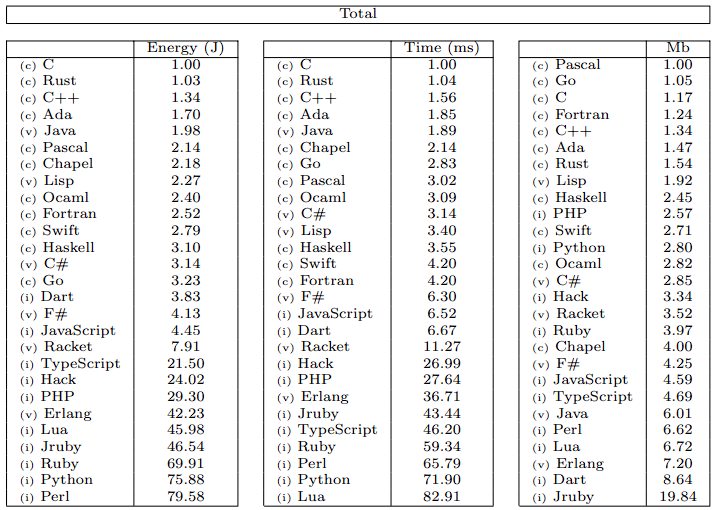
This comes to no surprise to me. Interpreted languages like Python, Perl, Lua, JavaScript, TypeScript etc. are by their very design, slow and energy wasteful because priority has been put on “ease of use” for programmers. This comes at a very heavy price: slow performance and energy wastefulness.
Compiled languages like C will always be outperforming and be much more energy efficient because C is much closer to the hardware and operating systems than interpreted languages.
Do people or organizations care of wasting energy and have lousy performance? They should. If organizations do not care, your customers eventually will see a difference in quality between scripted languages and taking the time to produce fast and energy efficient code. One can always see a difference between native applications and scripted/browser applications.
For example, let’s say you are creating a cloud-based applications that uses AWS Lambda to execute your functions. If that Lambda is written in Python, you are wasting time and money. Since Python so incredibly slow, you are being charged in 100ms increments when you execute your Lambda function in AWS. Now, imagine your Lambda function is written in C? Your Lambda function will execute so much faster and you are being charged much less. It will be more cost efficient to execute in C rather than Python. So, it would be cheaper and you are contributing to a lower energy consumption.
The same idea can be applied when you create a Linux daemon service, a Windows service, or even a native Linux, MacOS, or Windows application. Have a look at NappGUI, a cross-platform C SDK that allows you to create super fast and beautiful C applications.
C is a really powerful language. Have a look at it and start using it in your next project.

