Write the code first. Let it tell you what the book says.

Back in December 2024 I asked here whether anyone would be interested in a book about Event Sourcing and CQRS. I had a six page table of contents and a lot of doubt about whether I wanted to commit the time.

Well, I committed the time. Two years of it.

And I did one thing differently from what I planned, which turned out to matter more than anything else: I built the implementation first and let the code tell me what the book should say.

Sounds like a small decision, right? It is not. It rewrote chapters.

Let me show you one.

Snapshotting looks simple until you build it

Everybody describes snapshotting the same way. Your event stream gets long, replaying it on every load gets slow, so you periodically save the aggregate’s state and on the next load you restore that and replay only what came after.

That description is correct. It is also useless if you are the one writing the code.

I found four things while implementing it that no diagram tells you. Three of them ended up in the chapter.

The trigger is boundary math, not a modulus

You want to snapshot every fifty events. So you check whether the version is a multiple of fifty, right? version % 50 == 0. Done.

No. And here is the part that should worry you: it fails silently.

One command appends three events. Your stream goes from version 49 to version 52. It steps right over 50 and never lands on it. The check never fires, the snapshot never happens, and nobody tells you anything, because a missing snapshot looks exactly like an aggregate that has not hit the threshold yet. The load still works. It is just slow. You find out six months later when somebody asks why one aggregate takes 400 ms to load.

What you want is to ask whether the append moved the stream into a new bucket:

postVersion / interval > preVersion / interval

Integer division, evaluated across the append instead of at a single point. A multi-event append that jumps a boundary captures once, at the post-append version.

Simple fix. But I did not see it until I wrote the test that appends three events at once.

Do not upcast your snapshots

Events get upcast. Event shapes change, you write an upcaster to lift the old shape to the new one, and you maintain that chain forever, because events are immutable and you cannot go back and rewrite history.

So when the snapshot shape changes, you upcast the snapshot too. Right?

Wrong, and I am glad I found this in code rather than in print. A snapshot is a cache. The aggregate can always rebuild it from events. So when the shape changes, let the old snapshot read as a miss, rebuild from history, and capture a fresh one at the current shape the next time you cross a boundary.

Upcasting snapshots buys you nothing that a discard does not already give you, and it costs you a second chain of upcasters to keep correct next to your event upcasters. Two lineages that have to agree with each other, forever, where zero would do.

Put the schema version in the WHERE clause, by the way. Do not read the row and compare in memory. A snapshot at a shape you cannot read should never cross the wire in the first place.

Guard the restore or corrupt your writes

This one bit harder.

RestoreFrom(snapshot, version) seats state onto your aggregate and sets its version. That version is the concurrency token your next append checks against.

Now let somebody call that on an aggregate that has already applied events, or is holding uncommitted work. You just overwrote the token. The next append goes out with an expected version describing a state the aggregate is not in, and a stale write lands as if it were current.

In an event-sourced system! Where the whole promise is that the log tells you the truth!

So the restore throws unless the aggregate is pristine. Loud failure right at the seam, instead of silent corruption three layers downstream that you find out about in production.

Your speedup test cannot be a stopwatch

Obvious test: load with a snapshot, load without, assert the first is faster.

I have the scar on this one. The same code passed five out of five on a 32-core machine and starved on a shared 4-core CI runner. The scheduler widened the window and the timing budget stopped meaning anything at all.

Snapshotting does not save you milliseconds. It saves you replays. So test replays. Seed a stream past two boundaries, load through the snapshotting repository over a store that records where the read started, and assert two things: the read began at the snapshot’s version, and it replayed strictly fewer events than the full stream.

Machine independent, and it measures what the pattern is actually for.

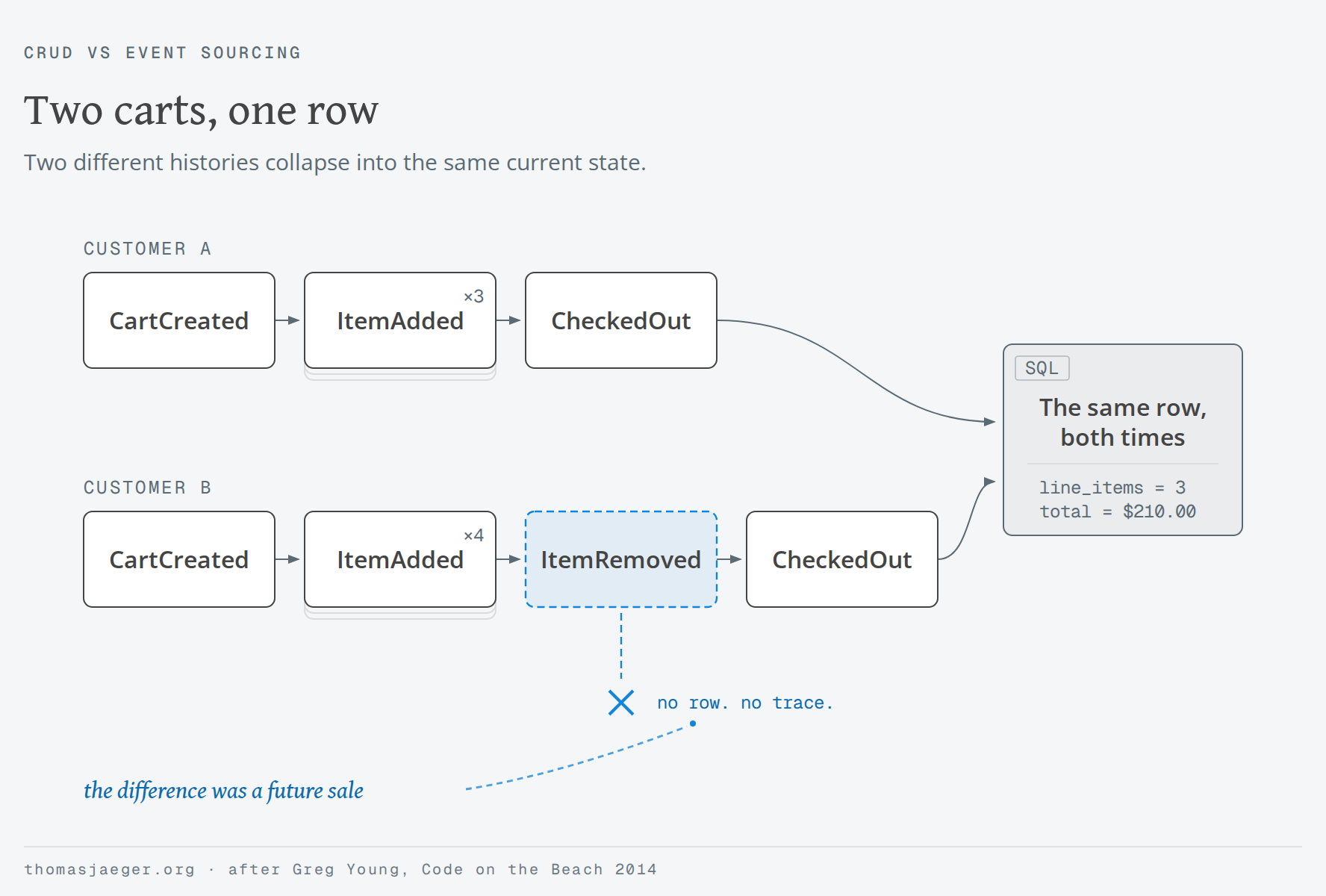
This happened across the whole book

The snapshotting chapter is not the chapter I outlined. Neither is the one on correlation tracing. Neither is the one on event versioning, and that one moved the most.

Every single time the implementation and the manuscript disagreed, the implementation won and the chapter got rewritten. Not once did I look at working code and decide my prose had been right all along.

And I think this is the thing nobody tells you about writing on architecture. Any pattern you can draw on a whiteboard has a layer underneath it where the real decisions live. Interval math. Concurrency tokens. What your test can honestly assert on a CI runner you do not control. You cannot write about that layer if you have not been down there, and readers can tell.

So here is my advice to anybody thinking about writing a technical book: build it first. All of it. Ship the code, run it, break it, and let it tell you what your chapters should say.

The manuscript is at 449 pages across 18 chapters now, with a production-grade reference implementation in .NET running on PostgreSQL, SQL Server, KurrentDB and DynamoDB behind one contract.

What would you want to see from a book like this? I am still listening.

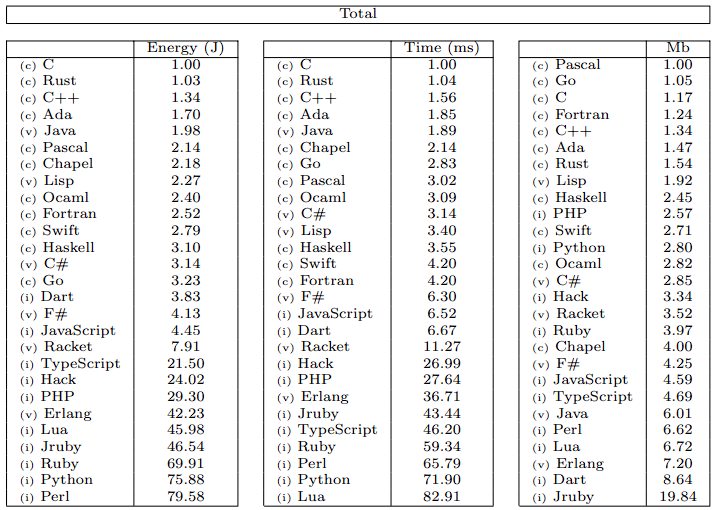
Python is 72x slower and uses 76x more energy than C

According to a recent study named “Ranking Programming Languages by Energy Efficiency” conducted by several institutions in Portugal, Python is incredibly energy wasteful. In addition, Python is also extremely slow when compared to the C programming language. See table below:

This comes to no surprise to me. Interpreted languages like Python, Perl, Lua, JavaScript, TypeScript etc. are by their very design, slow and energy wasteful because priority has been put on “ease of use” for programmers. This comes at a very heavy price: slow performance and energy wastefulness.

Compiled languages like C will always be outperforming and be much more energy efficient because C is much closer to the hardware and operating systems than interpreted languages.

Do people or organizations care of wasting energy and have lousy performance? They should. If organizations do not care, your customers eventually will see a difference in quality between scripted languages and taking the time to produce fast and energy efficient code. One can always see a difference between native applications and scripted/browser applications.

For example, let’s say you are creating a cloud-based applications that uses AWS Lambda to execute your functions. If that Lambda is written in Python, you are wasting time and money. Since Python so incredibly slow, you are being charged in 100ms increments when you execute your Lambda function in AWS. Now, imagine your Lambda function is written in C? Your Lambda function will execute so much faster and you are being charged much less. It will be more cost efficient to execute in C rather than Python. So, it would be cheaper and you are contributing to a lower energy consumption.

The same idea can be applied when you create a Linux daemon service, a Windows service, or even a native Linux, MacOS, or Windows application. Have a look at NappGUI, a cross-platform C SDK that allows you to create super fast and beautiful C applications.

C is a really powerful language. Have a look at it and start using it in your next project.

Proposed book about Event Sourcing & CQRS

For years, I wish I had a source that I can direct people to learn more about Event Sourcing & CQRS. Greg Young never created a book, sadly. The difficulty in Event Sourcing & CQRS is not so much the technical side but, as usual, the people you need to convince and work with. Typically, Event Sourcing allows for capabilities in your software that are extremely hard or almost impossible to do with old style software development. It is fairly easy to convince executives, product, sales, etc. that these new capabilities and insights for your customers can easily beat competition. So, why is Event Sourcing not used in like 85% of all software projects? I believe that there are different reasons but at the core, where can people go to? The Web? The Web shows all sorts of different views and many of them show inexperience and brushing Event Sourcing off as “too difficult” or “increased complexity”. WTF? Software by it’s definition is hard to do properly if you stay aligned with the business and the vision your organization has. I argue that Event Sourcing makes this actually easier, not harder!!! The CRUD virus shows its ugly head again!

So, after years of not having a great source for people to direct to, I’ve been seriously thinking of writing a book about Event Sourcing and CQRS. I have not pulled the trigger because I know this a huge time commitment. However, I did create a six page table of contents and surprised myself of how much information can and should be shared on this topic. This book would be very comprehensive and covers Event Sourcing from every angle including the business and customers side and not just the technical side.

My question would be, are you interested in this type of book?

My new course on Udemy: Build an Event Store in C# .NET for CQRS and Event Sourcing

I’m excited to announce my new course “Build an Event Store in C# .NET for CQRS and Event Sourcing“.

Real-time communication and feedback to your customers are more important then ever. Customers have become used to immediate feedback on the actions they take in your software. It is very hard in create, read, update, and delete (CRUD) based applications to provide this sort of responsiveness that your customers are demanding. Event-based solutions that are based on CQRS, Event Sourcing, and Domain-Driven Design (DDD) can offer deep insights in real-time to your customers and to your business. More importantly, you won’t loose data in an event-sourced solution when compared to CRUD-based solutions because your solution will be able to provide the context on why changes happened and record changes into an immutable log, the event store.

In this course, you will learn about the importance of using domain events as your source of truth instead of pieces of data that are incomplete in CRUD-based applications. You will be able to tell stories on what happened when and why. You will be able to answer future questions by your customers and business even though you may not have all the requirements at hand when you design and build your event-sourced solution.

At the very heart of your solution will be the event store. The event store is the source of truth in your entire solution. We will be building an event store in C#. NET and utilizing AWS DynamoDB as the persistence mechanism. However, the provided C# source code can easily be converted to Java or other languages. For the actual persistence, you could also use MySQL, PostgreSQL, MongoDB, and others. The C# code is abstracted so that can you can re-use it for specific persistence implementations. The concepts and code can work for on-premise, cloud only, or hybrid models. For an example read model implementation, we will be creating a read model using MySQL in AWS.

Once you understand the power of event sourcing, you won’t go back.

Design things to be replaceable, not reusable!

I love this quote by Andy Hunt

I find aiming to make things “replaceable” far better than making things reusable. Reusable means you’re fortune-telling, trying to divine an unknowable future.

This is what I’m aiming for as well especially when you bring in the Sacrificial Architecture. Love it.

As you create your architecture, design all components to be replaceable, not reusable. This is a whole lot easier nowadays with AWS and Lambda creating serverless masterpieces, for example.

What are Projections in an Event Sourced Microservice Architecture?

In this video I will show you the different types of projections in an event-based microservice architecture and how you can use them.

Projections can be created in code in your microservice or in read-models when domain events are received and processed, for example, you process a published domain event and then store the result of the analysis in Oracle, MySQL, SQL Server, etc.

Microservices

I just finished uploading the final video on YouTube of the little mini-series “Microservices”. Take a look here:

1. Microservices – Part 1 of 4 – What Is A Microservice?
2. Microservices – Part 2 of 4 – DDD
3. Microservices – Part 3 of 4 – Big Ball of Mud
4. Microservices – Part 4 of 4 – Event Driven

These videos are all available on my YouTube channel at: Creating Great Software


Why you need serverless microservices, yesterday!

I have just published my FREE course: Why You Need Serverless Microservices, Yesterday“. Enroll for FREE!

WhyYouNeedServerlessMicroservices_960x520In this course I will walk you through the many benefits of creating serverless microservices instead of the traditional node / instance approach including the use of containers. There are more than enough things to worry about when you want to create a new cloud system or transform a legacy system to operate in the cloud.

From a business point of view, there are huge benefits in going serverless rather than instance based (including containers). A very large jump in business agility can be achieved through focusing on the problems and opportunities rather than the technical jungle of traditional computing solutions.

From a technical point of view, it is almost nirvana where you can eliminate many points of failures in the architecture.